
PUBLISH’D AFRIKA MAGAZINE FACEBOOK SHORT STORY COMPETITION – August 2023 Leg/ Pamella Amethyst Brown


THEME: KNOCK YOURSELF OUT
TITLE: “REST”
Written by Pamella Amethyst Brown

My mother’s cries were the last thing I heard every night since my brother went MIA. It was heart wrenching seeing my mother loose against grief like that. We as kids had always seen our parents as impenetrable walls of strength. My mother unraveling at the seams not only was breaking her up to her atomic components, but it was also tearing the family apart. She had been figuratively the glue that helped keep the house together. My father was neck deep inside a beer bottle. I was a mess of emotions. But the one emotion that took the front seat was jealousy.
Yes, jealously for my brother.
It’s weird I know, but I was jealous of my missing brother. He’d been the golden child. Our parents clearly loved him more than me. I was their last born and only daughter but they worshipped the ground he walked on. When I say they gave him everything, I mean they gave him everything. He had his first car when he was 16 years old. They sent him to a private integrated high school, because they wanted the best education for him. When my time came for high school, my mother sent me to a township school that wasn’t even doing that well in regard of their passing mark. I never even cared about how fancy the school was. They could have at least sent me to a school that was strict and had a good passing rate.
No, not them. The best was always reserved for my brother.
Seeing them lose themselves when he went missing sent me up in flames. Even when I started getting reckless, they never noticed. I wished that they cared for me half as much as they cared for him. Even when he was gone – or in our case missing – they totally erased me out their view sight. I found myself sometimes for a spit second wishing that he was gone, permanently. That was a bitter possibility that my mother refused to accept.
My brother was in the South African National Defence Force navy, and his ship had gone radio silent somewhere around the Bermuda Triangle. A total of 321 men and women just gone like that, as if they had been ruptured or something. We hadn’t even known that he was that far away from home. Why was even our army that near the Americas? Was there something everyday people like us were missing?
We found out one warm day when two army brown cars drove up our long dusty driveway, their wheels pushing up dust and making it look as if a pack of wildebeests was stampeding across our front yard. Some of the downsides of staying in a farmhouse just a kilometer and a half outside the city was all the dust we had to deal with.
The cars pulled up in front of the house. My mother was already at the door. I assumed she was hoping it was her son, as we hadn’t seen him for a year up until that day. Instead, they gave her the bad news. It was like they had stampeded on her heart. She cried for days and as much as I was jealous of my brother, I felt for mother. She had given so much of her heart to him. Now there was a possibility that he had sunk to the bottom of the North Atlantic Ocean along with her heart. It was a fate far worse than death, for my mother. What is worse than a mother losing their child? I’ll wait…
***
I don’t remember much about the accident. What I could not get out my ears was the ringing. It was as if a phone was ringing right inside my ear. I don’t remember how I got out the taxi, but outside the world was ending. Smoke seemed to have taken up all the space, and a person could barely see two feet in front of them. The screaming. Jesus, the screaming was overpowering the ringing ten-fold. I navigated myself around the smoke and finally found the edge of it. I sat down and watched the wreckage as if I were watching an animal giving birth on the National Geographic Channel. It was an out of body experience. I could not take my eyes away from it. The image held me hostage the same way a pimple popping TikTok video did. There was just something about the burning people that just made me pause and watch everything in slow motion as the smoke cleared.
A woman was screaming her lungs out being held back by a boy in a school uniform same as mine. I didn’t recognize him. She was trying to get back to her baby who was inside one of the burning cars. She was bleeding profusely and close to death, but her motherly adrenaline was keeping her body just alive enough for her to witness her child being burnt alive.
A man walked out of the clearing smoke, as the hero would in an action movie, carrying the child. The women saw this and recognized the child in the man’s arms, and she stopped screaming and relaxed in the boy’s arms. I still didn’t know him. He looked to be in my grade or a year younger, but I just couldn’t place him. The man was limping badly as one of his legs was damaged to what seemed like beyond repair. He made his way to the woman. The mother took one look and smiled, as if she was satisfied with what she was looking at. She then just stopped. She stopped moving. The boy and the man looked at each other and a moment of silence felt like hours. It was an unbelievably unique moment to witness that happen in the middle of a car pile-up.
I would have probably witnessed the child waking up in the man’s arms, but the wailing of ambulances made their debut into this saga, redirecting my attention to then. They sounded as if a bunch of Banshees were screaming. Maybe that is what Banshees sound like. It’s just that we think it’s the ambulances that make the sound. Now isn’t that food for thought.
One ambulance stopped a few metres from me. People in green jumped up and whooshed past me. They attended to the motherless child, the man whose leg was long gone, the boy I didn’t recognize, and the newly deceased mother. I watched as more green dressed EMTs jumped to action to help other people who were still alive and holding on by doll hairs. It was a miracle that I had walked out without even a scratch. God must have had me on His lap when the accident happened.
Not a moment too soon, more fire trucks than ambulances made it to the scene and got to work trying to stop the fires. A field near the road was already up in flames. The crops were an inferno and those poor men and women in red had their work cut out for them. If the fire got worse, it would reach the city, and nobody wanted that. I felt someone place their hands on my shoulders.
“Pudding,” came a whisper.
I froze. Only one person called me that and right now he was most likely swimming with fish at the bottom of the North Atlantic Ocean.
“What!” I jumped up and faced him.
He looked bigger than I last saw him. He looked healthier and happier. I jumped on him, attacking him with a hug. The resentment and jealousy were out the window. My big brother was home.
“Slow down tiger before you strangle me,” he laughed, prying my arms from around his neck.
“Sorry, got too excited,” I grinned and tried to keep my knees from giving way. “Why are you here?”
“Well, the car couldn’t cross over due to this….” he gestured to the accident. “…so they dropped me off here. Are you okay? Were you involved in this?” he asked checking my whole body.
“Yes, but I’m totally fine,” I said, looking myself over to make sure that I was really fine.
“Are you sure? You don’t want the medics to check you?” he blinked and pulled a smile.
I smiled back. I never realized how much I had missed his smile. Even though our parents had treated him like Cinderella’s stepmother had treated her daughters and me like she had Cinderella, I and my brother had gotten along fine. He’d even taken my side a few times and spoke back to our mother, and as always, she never saw wrong in what she did to me, and she never reprimanded my brother for speaking against her or going against her wishes. The golden child always won.
“I’m fine. Let them attend to people that need the help more than I do.”
I took his hand and looked back. The mother was covered in a foil blanket, the child was being carried by a female medic away from the scene, the man was on a stretcher being attended to, and the boy was nowhere to be seen.
“Then can we go home. I could use the walk. I need some time with you.”
“What does that mean? You can’t be going back. You got lost at sea. I can’t lose you again.”
I held back tears. Not today’s tears. This was not your day. Maybe tomorrow, but not today. I’ve seen too much to cry now.
“No, I’m just… I’m just saying I don’t know when we’ll ever get time just the two of us.” He had teary eyes. He was fighting them as much as I was fighting mine.
“We’ll have to make time, you are home now…”
We walked away from the wreckage. I didn’t even know how many vehicles had been involved. Where on earth was my backpack even? At that moment I could care less. My mother was going to lose her marbles when she sees him walking through the gates. Maybe this time she’d see me too. She’d see that I had brought her baby back, and maybe give me a hug.
It was a very blissful moment of walking in silence. I felt so at peace. I had never felt this light in my life. Our farmhouse slowly came into view. Our father’s van was driving down the driveway heading for the gate, which was already open. The car flew the two yards to the gate and they didn’t even stop to close the gate. They always left the gate closed when they left the house. The car zoomed past us, as if neither of them noticed us on the side of the road.
“Where are they rushing to?” I watched the dust they left behind them as the car disappeared in the direction of the accident. “They didn’t even see us. Anyway, let’s go inside,” I said and shrugged. “They’ll see you once they get back.”
I started walking towards the gate, but he didn’t follow me.
“What’s the matter?” I looked at him. He was fiddling with the army uniform he was still wearing. “What?” I started to feel a pit in my throat.
“Pudding, look…” he sighed, “…Mama never despised you.”
“You can tell me all that inside, come.” I walked back to him and grabbed his arm. “Come.” I pulled but he didn’t as much flint.
“She loved you,” He sniffed. “She loves you.” Tears ran down his cheeks.
“No,” I shook my head. “Let us head inside please.” I pulled, nothing.
“She just had a colourful way of showing it.”
“Bhuti no.”
I remembered who the boy was. He was the boy that had gotten me pregnant.
“Pudding.”
“Bhuti.”
We were on our way from school to tell my parents. We had already told his. They hated it. They wanted me to send it back to heaven. I didn’t know what I wanted. I had thought telling my mother would help. In hindsight, that was probably the worst idea in the history of ever.
“Pudding, our road ends here.”
The boy had pulled me out of the taxi hardly alive. I was bleeding from my stomach.
“You never made it out The Bermuda, didn’t you?”
“None of the 321.”
I swallowed the lumped and I felt sick to my stomach. My stomach. I held it and felt a headache brewing. I wanted to scream. I wanted to scream louder than any Banshee had ever wailed.
“Come on, let’s go rest. You must be tired… I know I am.”
He flashed me that one-million-dollar smile of his. I smiled back. I didn’t feel better, but rest did sound nice. I really was tired.
Aren’t you?


PUBLISH’D AFRIKA Magazine Facebook Short Story Competition is funded by the National Arts Council, Department of Sport, Arts and Culture and Presidential Employment Stimulus Programme 3
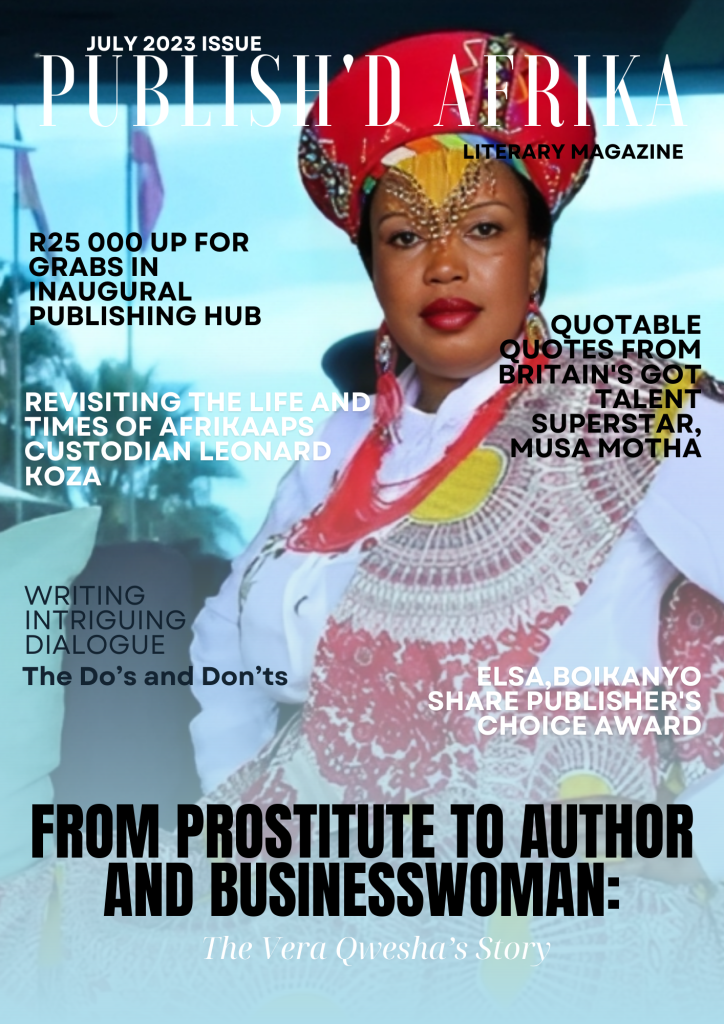

PUBLISH’D AFRIKA MAGAZINE FACEBOOK SHORT STORY COMPETITION – August 2023 Leg/ Bwalya S Kondwani


THEME: KNOCK YOURSELF OUT
TITLE: PAIN AND PENANCE
Written by Bwalya S Kondwani

Dalitso stood atop the tallest building at The University Teaching Hospital, soaked in the most violent storm Lusaka had seen in seasons. His tears blended into the rain like they weren’t even there. Poetic, isn’t it? For his tears to go unnoticed, just as his pain had gone for so long. They often called him troubled. All he ever wanted was to escape this hell, just that, escape, but how could he escape something within him? How could he ever escape himself?
He knew one thing for sure though – he could never find the forgiveness he was looking for, not here, not in this life. So if there really was a deity to grant him forgiveness beyond the sky, it would only take one more step to find it. So he took it.
As his body free fell from the roof, he got his last glimpse of lightning stretched across the dark night sky, the last beautiful thing he would ever see, accompanied by a harsh dissonance of thunder, which he took as God’s approval, heaven’s “welcome home”. Before the last rumble of thunder could be heard, everything went black for Dalitso, all the noise in his head was finally gone, and so was he.
***
It was Chimfwembe’s first night on duty as the hospital’s head of security. After being fired from his last job, he was vigilant, he wanted to make a good impression on this one.
The night had been peaceful so far, until the thunder broke through the noise of the rain, everything seemed to spiral into chaos from there. Chimfwembe was convinced it wasn’t just thunder he had heard, so he left his station and walked towards the entrance of the hospital to investigate, pulling himself through the strong winds of the storm. As he approached the gate, he heard a woman scream just outside the doors of the outpatient, so he put a tighter grip on his raincoat and ran towards her. He found her holding her mouth and staring at the body of a young man with his skull cracked open on the ground.
“Get inside madam,” said Chimfwembe, but the woman just stood there, her eyes locked on the lifeless body on the ground. “Madam” Chimfwembe said, as calmly as he could, “Please get inside and call a nurse for me, tell her to come with a stretcher and another security guard.” The woman left, hesitantly, she walked back into the OPD and about two minutes later a nurse and security guard came running through the doors with a stretcher.
“Mwelesa!” exclaimed the nurse, Chimfwembe and the other security guard carried the body on the stretcher, and took it straight to the morgue for an autopsy. The nurse called the pathologist on-call that night.
Dr. Chama was a pale, slim old man, he looked well over his retirement age, but he was good at his job and he didn’t seem like he had any life outside his work, so everybody just agreed never to ask, his age was between him and the human resources department. He strutted through the long hallway with the fervor of a man half his age. He found Chimfwembe standing at the entrance of the mortuary.
“Who are you?” asked Dr. Chama, in a raspy but high-pitched voice, while walking past him as though he hadn’t seen him.
“My name is Chimfwembe doc, I’m the new head of security.”
“You’re new?”
“Yes I am, doc.”
“Try not to vomit on the bodies or equipment.”
Dr. Chama spoke through the whole autopsy, recording every step as he did it. Chimfwembe could barely understand half of the things he said, it was mostly medical jargon, but he could grasp the basic idea of what he was doing. At some point the doc paused for a moment, stopped recording and called Chimfwembe to come closer.
“Where did you find this body?” he asked Chimfwembe.
“Just outside the left side of the OPD entrance.”
“Was he here as a patient?”
“Not according to the records, the name we found on his NRC was checked in as a visitor, but never checked out. I’m certain he jumped from the top of the building, I heard the sound of glass breaking, the thunder must have drowned out the sound of the impact, but I also found shards of glass scattered around the body.”
“Take me to wherever you found him,” said Dr. Chama. They hurried through the hallway, passed the OPD and made it outside to the sight of the accident.
Dr. Chama was quiet for a moment, and then whispered to himself, “That makes much more sense.”
“What do you mean doc?” asked Chimfwembe.
“Call the police.”
“The police? I thought he jumped.”
“Of course he jumped. What doesn’t make sense is that he died. Look up there, what do you see?”
Chimfwembe squinted to see what the doc was talking about, then he finally saw it. “A net?”
“Precisely,” said Dr. Chama. There were construction works being done to the building, and so, nets were installed as a safety precaution just in case one of the construction workers happened to fall. “If the boy simply jumped, he would have been caught by the net…”
“Doc,” Chimfwembe interrupted before he could finish, “I still don’t understand, if the boy had hit one of the windows on his way down, his body could have easily been propelled away from the trajectory of the net. Which would explain the broken glass and why he hit the ground.”
“You were a police officer before this, weren’t you?” asked Dr. Chama, “I’ve worked with many security guards here, most of them don’t even come in for the autopsy, much less care enough to come up with such a deduction.”
“I was a detective, until I was fired from duty for… misconduct.”
“That’s a shame, your deduction was almost right, except there are bullets in his head. This boy was shot, by a shot-gun to be specific. The bullets must have broken the glass, partly shattered the boy’s skull as he fell and the force propelled the body away from the net. The impact is not the only thing that the thunder had drowned out, the sound of the gunshot too. This boy would have survived this fall if it wasn’t for that gunshot. Which leaves two questions, how did someone sneak a shotgun into the hospital with you watching? And who was this person really aiming at?”
***
By midnight, the police had located the shattered window in order to find which room the gun had been shot from. The hospital was on lockdown, so that no one could either go in or out, but this was all unnecessary. When the detectives barged into the room they found an old couple holding hands on the bed, and a shotgun laid two steps away from the entrance of the room.
The man was Frederick Phiri, a mechanic, but before that he was an officer in the Zambia National Service, he was retired at a young age due to insubordination. Fred was a temperamental man, everybody knew that, he knew that.
The woman was Laura B. Phiri, Fred’s wife of 37 years now. Laura was a quiet and sheepish woman, she wasn’t one to argue, or even speak up. In a way she lived through Fred, he was always there to fill in the blanks. He said the things she couldn’t for herself, he stood up for her when she couldn’t, Fred was everything she couldn’t be, and having him in her life felt fulfilling.
Their marriage was far from faultless though, and for the past few years it had only gotten worse. Fred had started to drink more, he wasn’t as affectionate as he used to be. His protection did not feel like protection anymore, it felt more like imprisonment, he wouldn’t speak for her anymore, he now just barked orders, and she would fold into herself as she always did. Fred spent more time at the garage, Laura barely saw him.
They had a son, he was 22, but they never really saw him around. He was 18 when he left home and things were never really the same from then. He never spoke to his father, the last time they were in the same room they nearly killed each other. So Laura never told Fred that he’d come to see her from time to time, it would do no good. She felt alone, all the time.
Laura was in the hospital because of joint pains she had been having continuously, the doctors said they would keep her there for observation. It was nothing new, so Fred was in no panic, he just called her to tell her he would pick her up the next morning because he was too tired to sit with her all night.
There had been rumors of Laura cheating on him for months now, he never thought much of them, Fred knew she was far too scared, far too boring even to hold up an affair, so he just brushed them off. That night, a friend of his who worked at the hospital called him and told him that a strange young man had gone up to visit his wife and hadn’t come out for hours now. Furious, Fred took his gun, threw it in his truck and sped off to the hospital. He went straight to her room with the gun hidden in a bag. When he got to the room, he sprung it out, kicked open the door but only found his wife.
“Where is he?” he asked, in a low but angry tone.
“Fred, what are you talking about?” replied Laura, shaking from fear after seeing the gun in his hands.
“I said where is he, Larua!”
They went back and forth barking at each other, the anger in Fred’s chest kept building up, he felt like he was going to explode, and then finally, almost unaware of his own actions, he pulled the trigger.
The bullet flew passed his wife’s head, and straight through the window, shattering the glass. Laura’s screams, the sound of the gun and breaking glass, were all swallowed by loud thunder. The fear on Fred’s face was very vivid. He dropped the gun to the floor, walked over to his wife and hugged her, he held her tight. He kept spilling apologies like a mantra, there was nothing else he could think of saying except, “I’m sorry”.
Moments later, when the room had fallen silent again, the police barged in, Fred simply got on his knees, and put his hands behind his head. The tears could not stop rolling off of Laura’s wrinkling cheeks.
***
“Listen sir,” said detective Banda, as calmly as he could. All he needed was a confession. Fred had been cooperative thus far but none of what he said was conclusive enough. “You killed a man, whether you knew it or not, you did and that alone cannot go unpunished. On top of that, you are being charged with attempted murder of your wife.”
“I was not going to kill my wife!” barked back Fred, this was the first time he had raised his voice in this whole interaction.
“Oh, so you just brought the gun to play kankuluwale? In that case we should let you go.”
“The gun was meant for the man she was with, I already told you this, but I wasn’t going to kill him either. The gun was just to scare him. I am not a murderer.”
“There are easier ways to scare people than with a loaded shotgun. Don’t you think that was slightly excessive?”
“That’s the thing, that gun was not loaded, I haven’t loaded or used that gun in over 10 years. I knew that even if I accidentally pulled the trigger, nothing would happen. I would never intentionally put Laura’s life in danger.”
“There’s a boy in the morgue with a shattered skull. What you would or wouldn’t do doesn’t matter at this point, it’s what you did that does.”
A man walked into the interrogation and whispered something into Banda’s ears, detective Banda turned around to look at some papers in shock. He then turned back to face Fred.
“Mr. Phiri, are you currently aware of the whereabouts of your son?”
“Last I talked to him he said he was moving to Kafue, why?”
The detective glanced at the man standing beside him and exhaled heavily,
“The young man you shot, his name in Dalitso Phiri, aged 22. He came to the hospital to visit a woman in Room 33. Your wife’s room. He exited the room shortly before you arrived, but security did not see him leave the gate. Your wife says they had an argument and he just stormed out…”
Everything said after was drowned out by the ringing in Fred’s ears. The blood was flushed from his face, leaving him pale, he could not feel his fingers, and his mouth instantly went dry. He thought about Dalitso, his boy, his only child. He never hated him, he loved him so much, what he hated was how was becoming so much like him. That’s why he was so hard on him, he thought he could fix him before he was broken, but he only ended up breaking him. He killed his boy.
***
The sun made its way through the broken glass of the hospital room as it rose from the east face of the city, the light landed on Laura’s blanket, shining right on her tear stains. All that was going through her mind was that this would be the first of many sunrises her son would never get to see.
Chimfwembe stared at the blood stains on his hands. He picked up his raincoat and prepared himself to go home, awaiting that inevitable call from the human resources department.
Fred saw the sun through the glass widows in the back of a police car, tears running down his face. He knew Laura must have been watching the sun rise, she always loved to welcome the day. He wondered if she would ever forgive him.
***
A year later, the case had already been closed, Fred was serving 40 years of prison with hard labour, 39 now. Detective Banda was working on a robbery case, it was found that the culprits in this case were all linked to Dalitso Phiri. When investigated further, they found out that this gang had been conducting robberies for years now, and Dalitso was once part of them. Every time he’d go back home to visit, he borrowed his father’s gun and they would use it for the robberies. The last time he did that, he forgot to remove the bullets from the gun after the job, these were the very bullets that killed him.


PUBLISH’D AFRIKA Magazine Facebook Short Story Competition is funded by the National Arts Council, Department of Sport, Arts and Culture and Presidential Employment Stimulus Programme 3

PUBLISH’D AFRIKA MAGAZINE FACEBOOK SHORT STORY COMPETITION – August 2023 Leg/ Nompilo Gumede


THEME: KNOCK YOURSELF OUT
TITLE: THE ALLEGORY OF THE AFTERLIFE.
Written by Nompilo Gumede

“Time of death, 16:07,” the doctor pronounces my death to others. If I am dead, then how is it possible for me to hear what the doctor is saying about me? I want to ask myself many questions about my death, but my brain activity slips slowly away until I sink to complete darkness. The darkness does not linger for long. I open my eyes and realise that the stab wound I died from is no longer painful or visible. My body is bare, clear of all scars and rashes I acquired in the world of the living. I look around, inspecting my surroundings. I am starting to think I am in heaven. I am in a lush, beautiful paradise. I lie on the grass and enjoy the rest and peace I feel, peace I have never felt before.
“Khayelihle.” On top of the soothing experience I am currently indulging in, a calming unworldly voice nourishes me even more by calling out to me. I do not see the owner.
“Who are you? Where am I?” I am still amazed by the beautiful creation that surrounds me.
“I am God. Welcome to the spiritual heaven. Stand up and reflect on your life. You still have a long way to go,” says the voice, leaving me in disbelief. If I knew death was so peaceful, I would have never been scared of it. The wise man once said, “To fear death is nothing other than to think oneself knows what one does not.” Now it makes sense; the living has been ignorant. Presuming death might be the greatest of evils.
I was wrong; everyone was wrong.
As instructed, I stand up, and this crystal-clear lake catches my attention. It is so clean and calm that one can see what is at the bottom. I walk there to admire it.
At the bottom of the lake, I see a soothing thing that resembles a vision. I see a new baby crying until her mother lets her suck the nipple, her hands folded into a little fist. The little hand holds her future, her purpose in the world. She grows into a naughty toddler who always is rewarded with a smack on the bum for her naughtiness. This reflection is a cute sight; I giggle before it hits me that the baby girl is me.
I grow up to be a school child and progress to puberty. I start to sneak out of the home to see my boyfriend. I have my first sex that leads to pregnancy. My parents are disappointed in me, and my boyfriend runs faster than Caster Semenya when I tell him the news. I drop out of school and stay at home until I give birth. I leave the baby with my mother, steal her money and buy alcohol. I turn into a well-known alcoholic, disappointing my parents even more. The following year I decide to change my life. I pray to God for forgiveness. I apologise to my parents and decide to return to school and secure a future for this child I have brought into this cruel world. On the first day of school, I kiss my baby goodbye and promise her a better future. I hug my mother and father, telling them they will be proud of me. They both smile, already feeling proud, and I bid them goodbye.
Before I make it to the school gates, tragedy befalls me. Two men wearing balaclavas attack me, demanding my not-so-expensive phone. I have no intention of dying for a phone, so I give it to them without a fight. The other is thirsty for my blood; he stabs me with his okapi knife. One, two, three, four… he finally stops when his friend holds him. They both run away. My neighbour sees me and calls an ambulance. I make it to the hospital bed, but the doctors do not get a chance to attend to my emergency because my life journey ends there.
What I just watched is not a vision; this is a reflection of my life, just as God said. I want to feel sad as I left my baby too soon, but this world does not allow the feeling of sadness. All I feel is peace.
“The heaven of firmament awaits your arrival,” the godly voice says. Now that I am hearing it for the second time, it is a female voice. Is God a woman?

THE SECOND HEAVEN
I know what to do, and I move my eyes and see the small pathway. I follow the way, still admiring the beauty of this place. This is what I call greener pastures. Everything is more vivid than the physical world. The sky is brighter than usual, and the flowers are more colourful and fragrant. The air is fresh and uplifting.
“Welcome to the heaven of the firmament, the heaven of knowledge and understanding of the divine.”
Before me, there is something that resembled the scales of justice. I think today is my judgement day, where I account for all my sins. My heart begins to pound hard. I am surprised I still possess the feeling of nervousness. I have not stripped all my human emotions.
The scales are moving up and down, alternatively like a seesaw.
“This is a scale of your good versus bad. Whether this scale judges you badly or good, justice can only be served when there is balance,” the godly voice explains, its unnatural echoes calming my skyrocketing nerves.
The scales begin to move more rapidly. The left pan is black, symbolising good, and the right represents evil. I move closer to the scales to see what occupies these pans. In the world of the living, evil and good are merely adjectives that describe wickedness and its opposite. Today I might be seeing what bad or good looks like physically.
My wish barely comes true. As soon as my eyes land on both scale pans, I see water. An unknown force compels me to put my hands on the pans. When I put my hand on the left pan, the scales become stationary. Water channels the spiritual contexts of my actions and emotions. I do the same to the right pan. I then move away when the object begins to move again.

The right stays down. Does this mean the goodness in me outweighs the evil? I question my life. I broke most rules growing up, gossiped, had sex before marriage, lied, and so on. I can’t remember the good I have done except on my last day in the world of the living.
As if the scales can read my thoughts, the left pan descends while the right one ascends until they reach equilibrium.
“Your scale of justice is balanced because you lived a virtuous life. You made mistakes in your pan of sins, and you owned up to them in pursuit of the good. You did not just avoid the negative, but you strived for the positive. By understanding this balance, you understand divinity. Virtue is a gift from the higher power.”

THE THIRD HEAVEN
I have mysteriously relocated to the next heaven, the heaven. The woman’s Godly voice that has been speaking to me is not coming from anywhere. It now comes from me. With each step I take in this journey, I connect more to this voice. Now I can’t feel the nervousness. This place is channeling more happiness and peace. Not happiness in a sense of temporal bliss, but this is endless and has no boundary. Like I am glass and this happiness is water; it has filled me and is even spilling.
“You are in the heaven of ecstasy, and that is what you feel. You are getting closer to meeting God. Therefore, you need to be stripped of all other human feelings. This will happen through purification.”

THE FOURTH HEAVEN
“Now that the scales of justice have been balanced and have been connected to divinity, it’s time to purify all your sins in the pan of sins. To meet God, you need to be purified and be cleansed of all imperfections. You are now free from sin.”
As the rain continues to fall, I feel my body becoming lighter and my soul expanding. I feel as if I am being lifted by the gentle breeze and carried away by the clouds. The raindrops shimmer like diamonds, reflecting the light of the sun and bringing a sense of joy and wonder. I am surrounded by trees and flowers, releasing their sweet fragrance into the air. A rainbow appears in the distance as if to symbolise beauty and hope. The rain stops, and eyes shift from the rainbow to something shiny like gold. It is another pathway to heaven.

THE FIFTH HEAVEN
Now I feel like I’m in the heaven our parents and pastors told us about when we were growing up—a place carpeted by precious gems, glittering in the sunlight. Diamonds sparkle like raindrops creating a scintillating display of colour. Trees laden with jewels like sparkling harvest.
“Khayelihle,” the intensity of this inner voice reverberates like a thunderstorm, but the tone is warm and embracing. “Welcome to the heaven of the throne, the realm of wisdom. Before you proceed, you are to be made aware of the laws that govern your universe. The first one is the law of attraction. Everything you achieve in the world of living is something that you manifest. Everything you focused on was drawn to you. The second law is the law of cause and effect, the law of karma. You reap what you sow. Those who live by the sword die by the sword. The third one is the law of abundance; the world of the living has endless resources the living need. To attract what you need, visualise it. Therefore, to have a meaningful life, focus on positivity, be careful of what you sow because you will reap it. You focus on the lack; you manifest the lack,” the voice explains, each word resonating in every cell of my body.

THE SIXTH HEAVEN
After the universe insight session, I move on to the next realm. It is called the heaven of splendour. For the first time after passing the first heaven, I take a glance at my physical body and realise that it is metaphysical. I look like an unexplainable creature of the higher realm. My soul feels empowered. Like a spiritual Divine being, I feel the connection between myself and the physical world. Right now, I see my mother holding my child, weeping for me. I close my eyes, connecting my soul to hers, my heart to heart to her. I tell her everything is okay. As if she can feel my presence, she stops crying, wipes her tears, and passes my words to my child. It’s going to be okay. I have attained an ability to interact with the physical world. I am going to make a good ancestor or a spiritual guardian. The name of this realm matches exactly how I feel, splendid. I am in control.

THE SEVENTH HEAVEN
I finally reached the highest realm of the universe. All the flowers and bliss are no more. It’s pure white, with no colours or shadows. There is also no sense of space. There is only a sense of pure consciousness. I feel my consciousness expanding to hold within all existence. I’m no longer a separate individual. I am part of the divine consciousness that animates all creation. My separation from the world dissolves. I become pure awareness.
“Welcome to the heaven of might.” If this realm had a ground, I would have dropped my jaw to the ground. This is my voice; I have been talking to myself from the beginning.
“Where is God?” I say out loud.
The inner voice replies, “I am your higher subconscious. I am the supreme being within. God is within you. I am the infinite light. You and I are both subconscious and conscious. We are both in control of the universe. We can filter what is drawn to us. We are in control.”
After these words, I feel the compulsion to chant something.
“My deepest desires are within my dreams; I am connected to every creation. I am part of something greater than myself. I am surrounded by boundaryless possibilities. I am guided by endless wisdom. I am worthy of abundance, happiness, and meaningful life. I am filled with creativity, inspiration, and motivation. I am connected to the eternal flow of life.”

Beep, beep, beep. The sounds echo in my ears. I open my eyes, my nose overwhelmed by the hospital’s stale smell.
“She is back!” screams the doctor while my mother cries tears of joy and disbelief.
“I thought I lost my child. I thought you were going to abandon us. Why did you scare me like that? Where did you go?” She floods me with questions, not believing that I am back, back from the secret heaven.
“I was on a journey of self-discovery,” I proclaim.


PUBLISH’D AFRIKA Magazine Facebook Short Story Competition is funded by the National Arts Council, Department of Sport, Arts and Culture and Presidential Employment Stimulus Programme 3

R20 000 At Stake In Poetry Slam Contest


2023 Slam Poetry Competition Africa Poets are invited to submit an entry for 2023 Poetry Africa festival theme: Vote4Poetry: More Than Words. The poet is free to interpret the theme as broadly as possible but the poem must express the poet’s ideas related to matters such as human rights, justice and equality. The poem must demonstrate how the poet’s voice works towards strengthening South Africa’s Constitutional Democracy. We are looking for innovation, creativity and different integration of multimedia to engage with matters of human rights, justice, equality & democracy. A poem submitted for the competition can be in any of the official South African languages but it must have English subtitles. Poetry Africa is streamed globally and the use of English is for the purposes of being accessible to the festival’s global audiences. A poet may submit on only one entry for the competition. The poem must be submitted in a video format (MP4, AVI). Poem/video must be no more than 100MB. The video poem must not exceed 3 minutes in total. Entrants will be allowed a 10 second grace period. Failure to keep to the length prescribed, the poet might be disqualified. The poem submitted for the competition must be original and be the poet’s own work; and it should not have been submitted anywhere else (other digital slams/projects). The video must be original and not contain other people’s copyrighted material. In the event that the poet uses any other person’s content in the video (visuals or sound, etc) it is the onus of the poet to secure the rights of use for such content. The festival reserves the right to request proof thereof. Props, costumes and/or instruments are permissible in the presentation of poems. Poets may not do introductions to their poems. Poems that are shortlisted will be shared on the festival’s social media platforms. Entrants must be between the ages of 18-35 The Top Ten entrants will be invited to perform at the Poetry Africa festival semi-final Slam Competition in Johannesburg on Friday 6 October 2023. Where necessary the Top Ten entrants will be provided with flights from a major airport in South Africa to Johannesburg, 2 night’s accommodation in Johannesburg, per diems and a performance fee. The Top Five poets will be invited to perform at the Poetry Africa festival in Durban on Saturday 14 October 2023. Where necessary the Top Five entrants will be provided with flights from a major airport in South Africa to Durban, 2 night’s accommodation in Durban, per diems and a performance fee. The winner will receive an overall fee of Twenty Thousand Rand. Entrants must be between the ages of 18-35 Poets may submit their videos via WhatsApp to 071 420 5185. Poets must complete the entry form when sending their poems. Entries close on Friday 15th September at midnight The decisions of the panel of Jury will be final.

£18,000 A Month Grant For Fiction Writers


Apply for the 2023 Miles Morland Writing Scholarship

The Miles Morland Foundation Writing Scholarship

Grant
Scholars writing fiction will receive a grant of £18,000, paid monthly over the course of twelve months. At the discretion of the Foundation, Scholars writing non-fiction, who require additional research time, could receive an additional grant, paid over a period of up to eighteen months.

Scholar’s Undertaking
At the end of each month scholars must send the Foundation 10,000 new words that they will have written over the course of the month. Scholars are also asked to donate to the MMF 20% of whatever they subsequently receive from the book they write during the period of their Scholarship. This includes revenues as a result of film rights, serialisations or other ancillary revenues arising from the book written during the Scholarship period. These funds will be used to support other promising writers. The 20% return obligation should be considered a debt of honour rather than a legally binding obligation.

Qualifications
To qualify for the Scholarship a candidate must submit an excerpt from a piece of work of between 2,000 – 5,000 words, written in English that has been published and offered for sale, you must send clear evidence that the piece you upload as part of your application has been both published AND offered for sale. This will be evaluated by a panel of readers and judges set up by the MMF. The work submitted will be judged purely on literary merit. It is not the purpose of the Scholarships to support academic or scientific research, or works of special interest such as religious or political writings. Submissions or proposals of this nature do not qualify.

Scholarship Requirement
The only condition imposed on the Scholars during the year of their Scholarship is that they must write. They will be asked to submit by email at least 10,000 new words every month until they have finished their book, or their Scholarship term has ended. If the first draft of the book is completed before the year is up, payments will continue while the Scholar edits and refines their work.

Proposed Work
The candidates should submit a description of between 400 – 1,000 words of the work they intend to write. The proposal must be for a full length book of no fewer than 80,000 words. The MMF does not accept proposals for collaborative writing or short story collections. The proposal should be for a completely new work, not a work in progress, and must be in English.
Please note that if you are shortlisted for a Morland Writing Scholarship, you will be asked to send us a 3,000 – 4,000 word “chapter” of the book you are proposing to write on your scholarship year to help the judges assess your ability. Writers will be notified that they are on the shortlist at the end of October. Shortlisters will then have 15 days to return the sample “chapter”. In view of that, please do some advance thinking about the sample “chapter” you will have to provide if you are shortlisted.

Biography
Please also tell us in 200 – 300 words something about yourself and your background. People who reach the shortlist will be asked for further information about themselves and how they propose to write their book.

Fiction or Non-Fiction
The Foundation welcomes both fiction and non-fiction proposals. We are aware that non-fiction Scholars may need extra time for research, so the Foundation may exercise its discretion to offer non-fiction writers a longer Scholarship period of up to 18 months.

Starting time
The Scholars may elect to start at any time between January and June in the year following the Scholarship Award. Their payments and the 10,000 word monthly submission requirement will start at the same time.

Accepted works
The Scholarships are meant for full length works of adult fiction or non-fiction. Poetry, plays, film scripts, children’s books, and short story collections do not qualify.

Mentoring
The Foundation will not review or comment on the monthly submissions as they come in. However, each Scholar will be offered the opportunity to be mentored by an established author or publisher. In most cases the mentorship will begin after the book has been finished and the Scholarship period has ended. At the discretion of the Foundation, the cost of the mentorship will be borne by the MMF. It is not the intention of the MMF to act as editor or a publisher. Scholars will need to find their own agents and publishers although the MMF is happy to offer advice.

Residency
Please note that this is not a residential Scholarship. It is up to the Scholars what their living arrangements are during their Scholarship year.

Important Dates
Applications will be received between 1st July 2023 and 18th September 2023. Applications submitted outside that period will not be looked at.
All enquiries relating to the Morland Scholarships should be directed to scholarships@milesmorlandfoundation.com In order to apply, please click on the blue box that appears on any page of the website, entitled: ‘Morland Writing Scholarship Application’.
A submission of between 2,000 to 5,000 words as a Word document of work that has been published and offered for sale.

Proof of publication and proof of sale.
A description of between 400 – 1,000 words about the new book you intend to write.
A scan of an official document showing that you, or both of your parents, were born in Africa.
A brief bio of between 200 – 300 words.
Please tell us how you heard about the Morland Writing Scholarships.

Contact Information
Miles Morland Foundation
2nd Floor, Jubilee House
2 Jubilee Place
London
SW3 3TQ
+44 (0) 20 7349 1245
mmf@milesmorlandfoundation.com
For more information, visit:
https://commonwealthfoundation.com/opportunity/miles-morland-foundation-writing-scholarship/?fbclid=IwAR08r_hSoXnA_BIc9rnDdTTeZERqo_sIXYtxAxfcmUxZ53MZOzv7AJYYL50

Here’s Something For The Poets and Photographers


Tell A Story Of An African City

African urban space anthology The Flute is looking for submissions highlighting the tales of African cities. Please submit your chosen poems or images by September 1 if the theme appeals to you.
The Flute is edited by Olajide Salawu and Rasaq Malik. The anthology is looking to publish works in the genre of poetry and photography focusing on African urban spaces such as Lagos, Accra, Kinshasa, Lonligwe, Durban, Marrakesh, Nairobi, Ouagadougou, Dakar, Luanda, Yaounde, and more.
The theme of this issue is “African Urban Echoes“, defined as the flute of the city, the noise of the people at the park, the bus conductor shouting on top of his voice, the rhythm of the night taxi cab and the car honking games. In these echoes, there is resistance, hope, and anxieties all produced simultaneously as the power of art can transmit hope out of the bleak stories of African urban governance.

Read the inspiration behind the theme here:
In the words of Nigerian poet, Odia Ofeimum, “A city is like a poem. You enter it and you enter into a world of concentrated time.” Odia’s observation makes us think of the city as malleable, changing from time to time, switching tempo from moment to moment. The African city, we guess, can be fast and uncanny, and can offer the balm when we walk in its faith. The question then is, is the city like a poem? What kind of poem does the city produce to reimagine Henri Lefvebre, what kind of city does the poem produce? With a focus on African cities as an urban capture with many Surrounds, as described by Simone Abdoumaliq, we are thinking of how these urban centers carry the heritage of colonial violence in their walls, roofs, texture, and rhythms. How can we create stories that inspire a lifeworld not of struggles to counter the normativized narratives of African urbanity? What other forms of city do we have and hope to live in? We also imagine the South Africa urban poet Mongane Wally Serote chanting fervently against the darkness of Johannesburg as we deliberate on the “Sorrows of the Black City” in Muhammad al-Fayturi’s poetry. There are many questions African cities ask us, that we have not been able to answer.

Submission Guidelines:

Send three poems or two images with the subject line: “African Urban Echoes”
Write us a note on what has inspired you to write this poem.
We prefer a Microsoft Word attachment
Include your bio in the body of the email.
Deadline: September 1, 2023

There may be compensation for contributors.
Submit to: africanurban69@yahoo.com

PUBLISH’D AFRIKA Magazine Facebook Short Story Competition – June 2023 / Boikanyo Pela

THEME: KNOCK YOURSELF OUT
TITLE: THE FEMALE WARRIOR
Written by By Boikanyo Pela

I’ve heard tales of ferocious African warriors. I’ve read of their fortitude in overcoming fear and protecting their women and children, how fiercely they defended their lands and livestock. I’ve heard about men who are tall, Black and African, with thick muscles, men who are built like my father. For a very long time, in my small mind, my father represented the warrior. He would care for us and defend us like the legendary warriors.
My father, Ephraim, was a well-respected man. He worked in a mine a bit far from home. He would come home every month end without fail. Sometimes he would make it home twice in a month. Every time he entered the house, he brought joy with him. He never failed to make us laugh. When he left the house, he made sure to leave me, his daughter, with a little bit more confidence.
He was a good father. He loved my mother, he loved all of us, and he was a happy man. Thabo, my little brother, saw him as a role model. He would go outside every evening to lift weights just so he would look like my dad. I used to mock him because, despite his efforts, he was still small and lacked bulk. I thought he looked like a stick at times, and he didn’t like my candour. Of course, we did not get along that well, because I did not believe in his ‘fitness routine.’ He complained about the greasy food we ate, but I could not help think he needed a bit of fat. As one can tell, he was my annoying sibling, but behind closed doors, far underneath all the flesh and subcutaneous tissue, the heart guarded by my ribcage held a lot of love for him. It was not information he needed to hear, though. I had to act tough and insensitive in front of him. I had to be the older sister. The fact that he was a boy often meant that he could belittle me any chance he got. I wanted him to respect me, because despite being a girl, I was his older sister. For the longest time, I was glad he looked skinny. What would happen if he were all bulky like my dad? I would lose every fight we had, I thought.
I was a bit popular with the kids in the neighbourhood. My father bought cordial things for us, and I always had the coolest stationery. I would carry some pocket money to get atchaar and chips. I was a light eater, and so, I often didn’t finish my food. My friends appreciated my leftovers, because the atchaar I added to my food brought flavour to the plain food they served us during lunch at school. And so, I always had people following me around, especially during breaktime. I thought I was loveable and had a good personality.
My brother often argued that I was arrogant, and people only liked me for what I had to offer, but I begged to differ. I was a confident young lady and had a lot to offer. Outside of all the fame, I was smart. I found school way too easy and would often read extracurricular material. I liked stories about ancient Africa. The kingdoms and arrangements always intrigued me. I got fascinated and saddened by the way powerful women would not be given enough respect. Every piece that I read brought this strong feeling inside of me, and I decided to stand for women in the modern society.
Most of the time, I would think about my mother, who had so much talent and so much to contribute to the world. Despite her enormous potential, she chose to remain a housewife. I couldn’t understand why mother couldn’t just make her own money and avoid having to report all of her expenses to my father. Didn’t she long for freedom? My father was a good man, but he was too conservative. As a woman, the only way to get along with him was to keep your head down and listen more than you spoke. That is how he was reared. From a polygamous family, as the least favourite child, his first instinct was survival. His father had killed his mother at a noticeably immature age because she was seen being helped by the enemy by the river. We were not allowed to talk about it, but the story was quite known in our community. People talked and it was hard to ignore.
She was struggling to carry water from the river. A story of a fragile, pregnant woman, accepting the aid she clearly needed. When her husband heard of it, he decided that his reputation was more important than his heavily pregnant wife. He had to kill her just to set the record straight. He didn’t care if his unborn child would also die. A grandmother I would need, killed by my grandfather. Yes, my grandfather was a cold-blooded murderer. How could one ignore such a story?
I am not one to pass judgement on murderers; I have my own demons to contend with, and I have blood on my hands. I was troubled by stories of women being abused; you see. I couldn’t stand it; I’d read too much about it to realise how pleasurable the deed must have been for the culprit. The degree of rage someone felt when committing an act of violence against women made them the most heinous parasites, feeding on innocent, helpless souls. The imagination was simply too painful and revolting for me to stomach, but I still read about it.
As one might expect, I had no idea I’d be able to witness the deed.
One gorgeous Saturday morning, as we were tidying the house for my father’s visit later that evening, I came across an envelope. I opened it and read the contents since I was too inquisitive. It was an approved letter from my school. It was a letter of authorisation permitting my mother to use the school tuckshop! She had long desired the freedom I had always desired for her! I couldn’t believe it. I carefully closed the envelope and placed it back where I found it. I waited for my father to arrive in the evening.
We had supper together, as a complete family. We were laughing and it was a beautiful evening, one of those one would be too scared to ruin. At one point, my mother told me to go fetch the envelope from the little corner table in her room, she had something to show my father. I left the living room to fetch it, not knowing how to feel about this sudden confrontation. It felt like one, telling a man like my father that you wanted to make your own money as a woman could be easily digested as an insult. I understood why my mother had to share the news with him, though. She needed him to invest. She needed the capital.
I came back, holding the long-awaited envelope, and firmly placed it in my mother’s hand. I wanted her to know that I supported her, but I doubt that’s how she interpreted the strength I had invested into placing the envelope in her hand. She just gave me a disapproving look and proceeded to open the envelope. She passed the letter to my father. How could she forget that her husband was illiterate? It didn’t matter though, for he asked my brother to read the letter and explain it to him. He listened, as he slowly chewed his food. I tried to read his emotions from his face, but all I could see was his attentiveness.
At one point he looked down to his food, and it took him a few seconds to raise his head after my brother was done reading to him, but he eventually did. His eyes were red as he raised his head.
“So, all that I do for you in this house is not enough?” he finally asked.
My mother kept quiet. She looked as if she was regretting her decision. Was that fear in her eyes? The more I looked at her, the clearer it became. That was fear. Why was she so afraid of this man? I’ve heard her screaming a few times when my father was home, but I did not make much of it. Was she one of the women who suffer silently from abuse?
“Baba, the kids are old enough now, I don’t need to stay at home all day.”
I cannot remember a lot, but food was flying in just a split-second and all I could hear was echoes of a roar that sounded “woman!”. Was this still about the letter? I saw his firm hand on my mother’s neck and before I could digest anything that had happened, he pushed her down and started kicking her with his mine boots. Was this man still my father?
“Not in front of the kids, Ephraim!” my mother pleaded.
Had this happened before? Why was she too worried about it happening in front of us more than she was about it happening at all? The food my mother had spent so much time preparing was all over the floor. Nothing made sense, everything felt like a dream.
I took Thabo into my hands and tried to block his sight with my hand. He quickly removed it and started crying. I looked at my mother, crunched up, with her arms above her head. He was going to kill her. What was this about? Was he angered by the idea of her independence? At that moment, I wished Thabo was not that skinny, I wished he would do something instead of cry like a baby in a corner. I wished I could do something.
Mother was in pain! Mother was slowly dying, and I couldn’t just watch. I hated the fact that all I could do was remain frozen. I felt helpless. It was too fast for me to process any emotions, but I felt the story of my grandfather and grandmother replay somewhere in the part of my brain that wasn’t frozen. Ephraim started punching my mother, while occasionally strangling her. She was starting to look pale. Was that blood on her face? It was as if she was dying in his hands, and he couldn’t care less. Who was this demonic man? What had happened to my father?
I placed my eyes on one of my mother’s vases, and I picked it up. I didn’t know what I was doing, but I was acting, and I was saving my mother. I used all my strength to hit my father on the head with the vase. He turned to face me as he slowly bent to the ground. Our eyes locked, and I saw the anger in his eyes. He was no longer a warrior; he was no longer a protector. He was capable of killing me. I wasn’t ready to die, I had so much to live for. I felt this rush of anger and fear simultaneously, and I kept on hitting him with the vase, using all my strength. The world was still, it was screaming my name, and I did not stop. I saw a huge knife in the pile of food that had splashed on the ground, and I took it. I stabbed my father. He was no longer trying to fight back. It was over. I was safe, we were safe.
I slowly turned to face my brother in the corner. He was crying helplessly. I turned and locked eyes with my mother. Was that fear I saw in her eyes? She had bruises all over. I smiled at her. She opened her mouth to say something.
“What have you done?” she muttered softly.
I was exhausted. I had fought a beast. I felt weak, and I slowly let myself go. A lot had happened in just a few minutes. Right then, I knew my whole life had changed. I knew nothing would ever be the same. I blacked out.


PUBLISH’D AFRIKA Magazine Facebook Short Story Competition is funded by the National Arts Council, Department of Sport, Arts and Culture and Presidential Employment Stimulus Programme 3


PUBLISH’D AFRIKA Magazine Facebook Short Story Competition – June 2023 / Sydney Mulenga

THEME: KNOCK YOURSELF OUT
TITLE: GRACE’S CHOICE
Written by Sydney Mulenga

In the heart of the bustling capital city of Zambia, Lusaka, lies Mtendere, a vast and sprawling residential compound. Mtendere is home to a diverse community of families. At the centre of Mtendere compound lies Kazimai market, a small and yet vibrant market filled with hawkers of different wares. Sounds of bargaining, prices, traders announcing their products and trying to sweet-talk passers-by to have a look at them litter the air. As the crowd’s bustle passes, a stray cat casually makes its way through the market. A few paces behind it a little boy makes his way to pick it up. The cat belongs to his family; it was procured to take care of a rat problem that had plagued their small shop. This small cat has saved the family business from considerable loss. The sight of goods destroyed by rat teeth marks has not greeted them in the morning since the cat’s arrival. As the boy pursues the cat, he passes a thrift shop that deals in used clothes referred to as salaula by the locals. Inside, the shopkeeper is talking to a brown-skinned young girl.
“They fit you perfectly!” the thrift seller says, curling her tongue around her words.
Grace, the girl that is being convinced to turn into a new customer, scans the face of the woman for any traces of a lie; she needs the affirmation. Grace thinks the jean fits her perfectly too, but she doesn’t want the seller to see how much she likes it. That would make discount negotiations tricky later. Hawkers here have been known to exhibit reluctance to drop the price if and when they notice their wares have managed to seduce the buyer into liking them.
Grace also wants to make sure that the money her grandmother had gifted her for her birthday is spent on something as close as possible to the best she could get for her money’s worth. Money hasn’t been easy to come by. It is just her, her grandmother and her brother now and life hasn’t been kind.
“This jean was made for you,” the seller continues. “Just look at how it shapes your hips.”
The seller is a lovely woman; probably in her late 30s.Grace’s mother was about the same age when she died.
Grace blushes. “Okay nicholekoni. I’m short; can you give me a discount?”
After a few negotiations, the lovely woman gives way and neatly bundles the blue jean for Grace in a black plastic. Grace thanks her quickly. She is eager to get home and wash the jean so she could wear it later and there’s no longer a need for her to hide how much she likes the jean now.
“Zikomo, thank you, I’m going to go now,” Grace says exposing her crooked canine smile. The crooked canines add a childlike innocence to her smile and most people can’t help but smile back. This seller is like most people.
“Thank you my daughter, go well,” she says as a smile plays on her face.
As Grace steps out of the stall, her smile fades. A lump slowly begins to form in her throat.
“My daughter.” Her mother used to call her that, often when she needed Grace to do something she knew Grace wouldn’t be too happy about. She would call out, “Grace my daughter!” After Grace came to her, she would often go on to say, “I know you’re tired and want to play but…”
Grace didn’t like it then. “My daughter” after her name was always precursor of unreasonable request from her mother but now, she misses it and yearns to hear it again.
“I’m sorry,” a little boy apologises to Grace after bumping into her.
“It’s okay,” Grace replies without thinking about it. “Just watch where you are going.”
“I will, thank you,” the boy says with a smile,
The boy turns his attention to the cat in his arms and whispers, “See what you’ve caused?”
The lump that was in Grace’s throats dissolves.


Grace was 13 when her father died, young and confused as she tried to make sense of her pain. Before she could make peace with the reality of being an orphan, two years later her mother died. The cancer took her quickly. The doctors said it was discovered too late. The family gossiped about how caring for two kids with no one to help but her old mother was more than she could bare.
When her mother died, Grace was 16 and her brother was only seven. The day of her mother’s funeral she held him close as both wept as her grandmother held them both. She was torn at the seams, a double orphan at just 16.
The funeral environment suffocated Grace; it was too constant a reminder of what she had lost. So whenever she got the chance, between the condolences from never seen before relatives and people telling how good her mother was to them, she snuck away. She stayed close in case her brother or grandma needed her for something. She stood with her friend, Jane, about 50 meters from the funeral house. They were making small talk when Grace noticed two of her maternal aunties heading in their direction.
“Iweh Jane, let’s go further into your yard. I don’t want my aunties to see me.”
The two girls retreated further into the yard. When her two aunties passed by her, they were in loud conversation.
“See, that’s the problem. Look at how no one wants to take care of the kids because of how Amake Grace didn’t want to visit…”
The oblivious aunties walked out of earshot. Jane placed a comforting hand on her shoulder like she had the last two days as Grace started tearing up.
At her mother’s funeral, her relatives stuck around just long enough for the burial and to share her mother’s belongings, and then they all sat down and decided her and her brother would stay with their maternal grandmother. Grace was allowed to pick first, a few mementos to hold on to. Afterwards everyone from distant family members to neighbours she only exchanged simple pleasantries before now, shared her mother’s clothes amongst themselves. Family members picked first.
“We will be sending money for food and upkeep for the children. It takes a village to raise a child, our family is our village. So we can’t let these kids suffer just because our sister, their mother, has left,” echoed one old man Grace had only seen him on two occasions – both were her parent’s funerals. The first time was at her father’s. He wasn’t given as much time to talk then as he was now.
That was also the last time Grace saw this man or most of her family members. The money for food and upkeep never came.


Grace reaches home. Her brother James is playing with his friends in the yard. Best not to bother him, she reasons. Her grandmother is in the living room. Their house is a four roomed house made up of a living room, the kitchen and two bedrooms. Grace and her grandmother share a bedroom.
“Gogo, I’m back,” Grace announces.
“Show me what you bought,” Gogo replies without looking away from the telenovela playing on the TV.
“Let me wash it first apa, I’ll show you later.”
Grace is about to hang the jeans when her hears her friend ask her grandmother about her in the house.
“Jane, I’m at the back!” Grace shouts.
When Jane comes out to the back, the two friends share pleasantries and begin to catch up,
“I can’t stay long; I have to pack to leave for Serenje.”
” I’m really happy for you ba soon to be teacher.”
“I have to pass that enrollment interview first. Any news on the your getting into college?”
“I haven’t gotten my results yet, as we still owe the school that,” said Grace. “I’ll try applying for a student loan. We just need to raise the money to pay the school.” Grace’s face is starting to drop.
“So have you decided what you are doing for your big 18th birthday tomorrow?” Jane changes the subject.
“I was just going to chill at home with Gogo and James, since you decided to abandon me,” Grace says.
“You know I’m not abandoning you,” Jane interrupts with a laugh.”I need to attend the enrollment interviews tomorrow, and I have to pack today.”
“I know, I just wished you would be around. Won’t be as fun with just Mimi and I.”
“Wait, I thought you said you were going to stay here with Gogo and James,” Jane says.
“I was not finished, I was about to tell you that Mimi asked me go out with her.”
“Isn’t Mimi’s idea of going out, just going to a club and having men buy her drinks?”
“She promised me we wouldn’t be bothered by any men, it will be just us.”
“Are you sure?”
“She promised.”
“Well I don’t think you should go. Mimi can’t be trus..”
“Hey you two!” Mimi announced. “James told me you are back here.”
Gogo didn’t like Mimi either, so Mimi tried to minimise interaction between the two.
Barely five minutes after Mimi joined the two friends, Jane said her goodbyes and as she was leaving, she told Grace to think about what she had said.
“What is that about?” Inquired Mimi.
“It’s nothing, school things.”
“Okay, so what are you wearing tomorrow?”
“I bought these jeans, ” Grace pointed.
“I have the perfect white top that will go with that.”


It is the next day, Grace’s birthday. As Grace did her chores, she considered Jane’s reservations about trusting Mimi. She thinks about how her and Mimi met a little after Grace’s mother died. Mimi was a double orphan too. She lived with her grandmother too and the shared pain drew the girls to each other. Mimi’s childhood was rougher than Grace’s. And of late Mimi life has taken a turn; she had started going out and speaking about men that gave her money after she spent time with them in expensive lodges. Grace didn’t want to get sucked into that world. Her grandmother wouldn’t be happy about it and she was certain her mother wouldn’t approve. Mimi had promised her she was taking her out to a good place and they wouldn’t stay out late.
Mimi picks Grace up later that day.
“You look fire in those jeans, Grace.”
” Thank you,” Grace blushes.
“So where are we going?”
” it’s a surprise.”
Grace had a slight idea what the surprise would be. Mimi had been trying to invite her to go a club with her for quite sometime. She was still reluctant about going with Mimi.
“Okay ba birthday girl, let’s go.”
Mimi and Grace walk into the club, the loud music and flashing lights make Grace feel overwhelmed. She isn’t used to being in such a crowded and noisy environment.
“Let’s go get some drinks!” Mimi yells over the music and grabs Grace’s hand. She leads her to the bar. After they reach the bar, Mimi leans into Grace and yells again, “Trust me Grace. You will enjoy this. I’m going to get you a nice cocktail.”
As Grace reluctantly sips her drink, she finds it isn’t as bad as she had imagined it would be. After a while she finds herself enjoying the music. Some of Mimi’s friends join them and they all dance together.
Suddenly, Grace feels a tap on her shoulder. She turns around to see a man probably in his early 30s smiling at her.
“Would you like to dance?” he asks.
Grace hesitates for a moment, but Mimi urges her to go for it.
“I need to go to the bathroom first,” Grace says to Mimi.
Mimi points her to the direction of the bathrooms. Grace makes her way to the bathroom. She uses one of the stalls and on her way out stares in the mirror a while.
“What am I doing?” she whispers to herself.
“What was that?” a random woman asks Grace.
“Oh, nothing,” Grace hurries out of the bathroom.
Mimi is waving to her in the distance, and the man is standing next to her. As Grace heads in their direction, she freezes mid-step and her heart drops to her stomach. Walking towards her is her mother. Her wonderful eyes, her smile, her cheeks have the same dips as they always have. She says something, Grace can’t quite hear her over the music, but she can make out the words from her mouth, “Grace my daughter”.


PUBLISH’D AFRIKA Magazine Facebook Short Story Competition is funded by the National Arts Council, Department of Sport, Arts and Culture and Presidential Employment Stimulus Programme 3